Anyone who studies chance-based games will consider Turbo Mines a fascinating subject. It’s a game that presents probability in easy clickable tiles. At its heart, it’s a mathematical puzzle. Every move you do is a risk with changing odds. Getting a grip on those numbers doesn’t take away from the fun. It transforms how you play. You cease guessing and begin making moves. This article will walk through the basic math that runs Turbo Mines. We’ll examine how your chances shift with each click and discuss ways to approach the grid in a smart way. The aim is to give you the understanding to perceive the game for what it is and to place your bets with more confidence.
With the math as our base, we can discuss real strategies. The central strategic choice in Turbo Mines is when to cash out. Since risk increases with every tile, a conservative approach involves setting a low target multiplier and cashing out consistently. For instance, you might choose to always cash out after 3 safe tiles. This gives you a high probability of success on any single round, but your wins will be lower. An aggressive strategy seeks higher multipliers, accepting the much lower likelihood of getting there.
No strategy erases risk. They only help you manage it. The trick is to select one that matches your goals and then adhere to it. This avoids emotional decisions in the thick of the moment, which usually cause chasing losses or giving back winnings.
The analogy comes naturally, but the two games are essentially distinct in how they leverage information and chance. Traditional Minesweeper is a game of pure deduction. Tap a safe square and it displays a number showing how many mines touch it. This provides you with exact spatial clues to determine where mines are located. You employ probability only when logic runs out. Turbo Mines, meanwhile, is a challenge of statistical chance and risk control. You receive no positional hints. The only stats that are relevant are the aggregate numbers: starting tiles, starting mines, and revealed tiles.
This distinction is critical. If you view Turbo Mines as a deduction game, you’ll get frustrated. You have to accept it for what it is: a round-by-round wagering game where math informs your risk, but luck determines each spin.
Any analytical player will ask: “Are the results truly random?” In digital games like Turbo Mines, outcomes come from a Random Number Generator (RNG). A properly built and audited RNG ensures each tile’s status as a mine or safe is chosen randomly when the round starts. There’s no pattern to predict. This is the basis of fair play. For you, it means the probability calculations we’re talking about are valid models of how the game behaves. “Hot streaks” or being “due for a loss” are not real. The odds for each click are set purely by the remaining tiles and mines at that exact instant.
Knowing the RNG drives everything supports using probability-based strategy over superstition. You can’t outsmart a genuinely random sequence. Your edge comes from controlling your decisions inside the known statistical framework. Reputable gaming platforms use provably fair systems where you can verify the randomness. As a player, knowing the game uses https://www.crunchbase.com/organization/bet-seven-online a certified RNG lets you trust the math you apply. It transforms your mindset from hoping for luck to executing a plan based on calculable risk. That’s a stronger, more satisfying way to play.
Several persistent myths may interfere on a player’s judgment. The main is the “Gambler’s Fallacy”: the idea that after a string of safe tiles, a mine must appear. This is entirely false. If you have remaining 10 tiles holding 3 mines, the probability for the next tile remains 3/10 (30%). It makes no difference what happened during the previous 15 tiles. The past has no effect on the independent random event of the next click. An additional misguided belief holds that certain tile positions provide better odds. On a grid using a truly random mine placement, every unclicked tile has exactly the same probability of hiding a mine, given the current remaining mine count.
Players frequently create rituals or patterns, like routinely commencing from a corner, thinking it improves their luck. This constitutes an illusion of control. While you decide which specific tile to click first, the mine layout is determined randomly ahead of that click. Clicking the top-left tile instead of the center tile doesn’t alter the overall starting probability for that click. Identifying and dismissing these misconceptions is crucial for clear, math-based thinking. It prevents you from making choices rooted in imaginary patterns and maintains your focus on the variables you can actually control: your cash-out point and your stake size.
Initially, let’s understand how Turbo Mines functions. You observe a grid of tiles. A certain number of mines are placed behind them. Your goal is to select tiles one at a time without striking a mine. Every empty tile shows a multiplier that increases your possible win. You can cash out anytime to lock in that multiplier, or you can keep going. The big difference from standard Minesweeper is the absence of “number clues.” You don’t get hints about nearby mines. Each fresh safe tile is an separate event based solely on what’s still present in the pool: leftover tiles and mines. This arrangement creates a clean probability problem. Your sole information is how several tiles you’ve opened and how numerous mines were placed at the start.
Each round of Turbo Mines begins with a few of fixed numbers https://turbomines.net. The grid size, like 5×5, gives you 25 in total tiles. The number of mines is likewise set from the outset—for illustration, 5 mines in that 25-tile grid. From your very first click, these numbers commence to influence each other. Your starting chance of striking a mine is merely (Number of Mines) / (Total Tiles). But that chance doesn’t stay still. It shifts with every safe reveal because the pool of remaining tiles gets smaller. This is certainly not a game of drawing with replacement. Each pick impacts the next, a textbook case of dependent probability. Seeing these shifting odds is the point at which strategic play commences.
This is the stage at which strategy actually matters. The game presents a rising multiplier in your sight, but the hazard rises at the identical time. Not a single strategy can guarantee a profit. Each round is its unique self-contained puzzle of risk and reward. You can calculate the statistical expectation, but the consequence is consistently binary: you one of two ways cash out and win, or you strike a mine and sacrifice your stake. So, comprehending the mechanics hinges on handling that struggle between greed and caution. Your compass through that tension is the set of cold, hard numbers that determine your chances at every single step.
The shifting odds are what render Turbo Mines so engaging to think about. Any click that doesn’t end the game gives you perfect information. You are aware of the exact number of tiles left and the unchanged count of mines left. Let’s expand our example. Suppose you’ve successfully uncovered 5 safe tiles. Now, 20 tiles remain, with 5 mines still hidden. The probability your next click lands on a mine is 5/20, or 25%. If you confidently open 10 safe tiles, 15 tiles are left with 5 mines. That gives the probability 5/15, or 33.33%. This progression is not linear in how it seems. The leap from 20% to 33% is a substantial rise in danger.
It assists to imagine this as a curve. The risk begins at a fixed point, for instance 20%, and climbs slowly at first. Then it grows steeper as the number of safe tiles diminishes. Envision opening 15 safe tiles in our 5-mine, 25-tile scenario. Only 10 tiles would stay. The probability the next tile is a mine is now 5/10—a straight 50/50 coin flip. This is a major mental threshold. The multiplier might look very appealing here, but you’re literally wagering on a coin flip. Comprehending this curve lets you to set personal risk limits before you even start playing. That’s a indication of a methodical strategy.
Let’s begin with the simplest part. Visualize starting a game on a 5×5 grid with 5 mines. On your first click, with all tiles untouched, you have 25 choices. Five of them are mines. Your chance of hitting a mine right away is 5/25. That simplifies to 1/5, or 20%. Your odds of picking a safe tile is 20/25, or 80%. This is easy arithmetic. The multiplier value shown on that first safe tile is set by the game’s own model. It is not a direct result of this probability. Keep the idea of survival chance separate from the reward multiplier. They’re linked in terms of risk, but the game computes them independently.
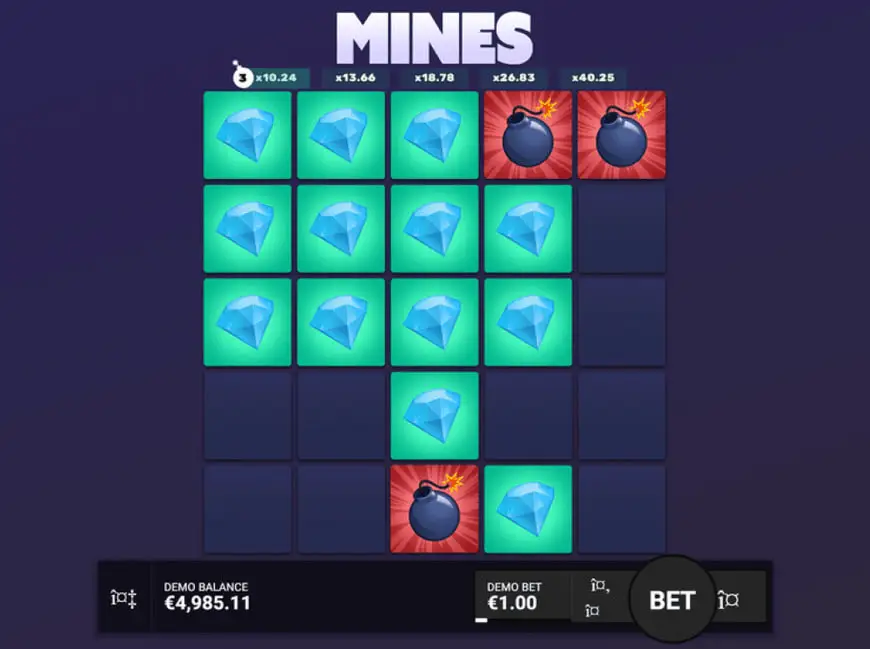
This initial probability is the only time the math remains this straightforward. Once you uncover a safe tile, everything changes. You now have 24 tiles left, annualreports.com but the number of mines is still 5 (assuming you didn’t hit one). The new probability of hitting a mine on your next click becomes 5/24. That’s about 20.83%. The chance of safety is 19/24, roughly 79.17%. Note the risk has gone up, just a little. This small rise in danger continues with every safe click. This is the core mathematical rule of Turbo Mines: with every safe step forward, the path behind you vanishes, and the path ahead gets statistically more dangerous.
Probability tells you the chance of something occurring. Expected Value (EV) shows what that occurrence is priced at on typical over many, many attempts. In Turbo Mines, at any choice moment, the EV is calculated by balancing the possible profit against the possible loss, times their probabilities. The calculation is: EV = (Probability of Cashing Out * (Stake * Multiplier)) + (Probability of Hitting Mine * 0). Since hitting a mine yields zero, that second term often drops away. A more valuable pre-game calculation relates to the likelihood of attaining a particular multiplier level.
For instance, what’s the probability of safely opening 5 tiles in a row? In our standard case, it’s the product of each separate safe probability: (20/25) * (19/24) * (18/23) * (17/22) * (16/21). Work that out and you arrive at about 0.20, a 20% likelihood. If the multiplier for 5 tiles is, say, 3x, then the EV for trying to achieve that point from the beginning is (Probability of Success * (3x Stake)). This is a streamlined model. The actual game’s payout system has more intricacy. But the principle is essential. A positive EV implies a action that would be rewarding over infinite repetitions. Recall, each round is independent, and volatility can be extreme over a short stretch.
Leaning only on EV has drawbacks in a game like this. To begin, the estimate presumes you are aware of the exact multiplier increments, and these can change. Next, and more important, it ignores your personal comfort with risk and the scale of your funds. A strategy with a slight positive EV might push you through lengthy stretches where a single loss destroys your session stake. I consider EV as a theoretical reference, not a strict order. It shows me if the game’s available multipliers are fairly valued against the probabilistic risk. That aids recognize times where acting more assertive or more cautious might make sense.
So how do you take all this theory to the online grid? First, always examine the game settings at the start: grid size and mine count. Do the quick mental math for the starting risk (mines divided by tiles). Second, determine your strategy before your first click. Are you playing for small, frequent wins, or aiming for a high multiplier? Define a clear cash-out point based on a tile count or a risk percentage. Third, manage your bankroll without mercy. Never wager more on one round than you’re willing to lose. Even a 95% safe chance still fails 1 in 20 times.
The goal of understanding the math isn’t to “beat” the game in a surefire way. It’s about making informed choices, manage what you expect to happen, and enjoy engaging with a well-designed system of chance. When you frame each click as a probability calculation, you shift your play from reactive to proactive. That is what a thoughtful player does.